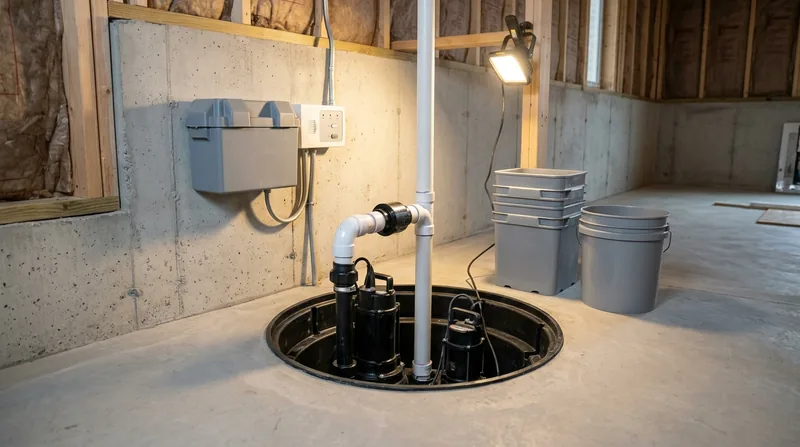




Lincoln sits in the Salt Valley on silty loess and heavy glacial clay, and that clay swells and shrinks with every freeze-thaw cycle. Homes in Near South, Havelock and University Place run on full brick or stone basements, while 1990s and newer builds in Fallbrook, Waverly and Hickman sit on poured-concrete walkouts that take fast runoff from prairie thunderstorms. When the power drops during an ice storm or a spring squall, your primary pump stops and the basin fills. Battery Backup Sump Pumps in Lincoln keep the impeller turning on a dedicated DC pump and deep-cycle battery, so water never gets a free run at your floor. We size the unit to your pit, wire it clean, and test it under load before we leave. If you want the full picture of how a backup fits your drainage, start with our sump pump installation and replacement page.
Why a Backup Pump Earns Its Place in Lincoln Basements
Lincoln gets wide-open prairie weather: fast thunderstorms dump an inch in twenty minutes, spring snowmelt pushes the water table up along Salt Creek and Antelope Creek, and hard freeze-thaw winters crack and shift clay soil. A primary pump that quits during the exact storm that matters most is the most common wet-basement call we run. Older foursquares in Hartley and Clinton have shallow brick pits that fill fast, and newer Fallbrook builds move a lot of volume through a single basin.
- Ice storms and straight-line winds knock out power for hours, and that is when the basin fills fastest.
- Primary pumps fail from float switches, jammed impellers or a tripped breaker, and the backup covers the gap.
- Spring snowmelt pushes the water table up for weeks, so the pump runs almost continuously.
- Clay soil sheds runoff instead of absorbing it, so sump inflow spikes within minutes of a storm.
A backup pump is not a luxury add-on in this climate; it is the piece of equipment that keeps a finished basement dry when the grid goes down.
Key info: A homeowner in the Country Club neighborhood lost power for nine hours during a July storm and took two inches of water across a finished basement. A backup pump with a fresh AGM battery would have run that entire cycle and then some.
For official guidance on plumbing and drainage permits in the city, check the City of Lincoln building and safety pages before you alter a discharge line or sanitary connection.
How We Install a Battery Backup System in Lincoln
We treat every pit differently because a 1920s brick basin in Havelock is not the same as a 2010 poured pit in Bennet. The goal is a backup that switches on automatically, alarms before the battery dies, and discharges where the water will not loop back to the foundation. We check the primary pump first, because a backup bolted onto a failing primary is wasted money.
- We inspect the basin, the primary pump, the check valve and the discharge line to confirm the setup can accept a backup.
- We size the DC pump and battery to your pit depth and the volume your primary moves during a storm.
- We mount the controller, float and alarm, then wire the battery on a dedicated circuit with a trickle charger.
- We run the discharge to a point that drains away from the footing, not back against the wall.
- We fill the basin and test the backup under load, then walk you through the alarm and the monthly test button.
If your pit is shallow or your discharge is undersized, we tell you before we sell you a battery, and we point you to the right fix on our interior drain tile system page.
Key info: In a 1950s ranch near Woods Park, the existing pit was only 14 inches deep and the discharge ran into a flower bed against the wall. We set a deeper basin, rerouted the line to the grade break, and the backup now cycles clean instead of recycling water.
Backup Pump Options We Install in Lincoln
Not every basement needs the same rig. A small brick pit in University Place may only need a compact DC unit with a single battery, while a large walkout in Hickman with a high inflow rate needs a higher-capacity pump and a second battery. Here is how the main approaches compare.
| Approach | Description | Best for |
|---|---|---|
| Compact DC backup | Small DC pump with a single AGM battery and a float switch. | Shallow brick pits in older Lincoln foursquares. |
| High-capacity DC backup | Larger impeller and dual battery bank for longer runtime. | Deep pits and high-inflow walkouts in Fallbrook and Waverly. |
| Combination primary and backup | New AC primary paired with a DC backup in one basin. | Aging primary pumps in 1950s and 1960s ranches. |
| Alarm and monitoring add-on | High-water alarm plus battery health indicator on the controller. | Any finished basement where a wet floor is costly. |
We match the approach to the pit and the inflow, not to a catalog page, and we tell you when a simpler unit is the honest answer.
Battery Backup Sump Pumps Cost in Lincoln: What to Expect
Most Lincoln homeowners land somewhere between a straightforward swap and a full combination setup, and the price tracks the pit, the battery bank and the discharge work. We start battery backup sump pump work at $900, which covers a compact DC unit, a fresh battery, a controller and a load test in a standard pit. A high-capacity unit with dual batteries, a deeper basin or a rerouted discharge line moves up from there.
The variables that move the number are pit depth, the condition of the primary pump, whether the discharge needs rerouting, and how much runtime you want during a long outage. A 1920s brick pit in Clinton often needs more prep than a 2015 poured pit in Bennet, and a walkout near the Salt Creek floodplain may need a larger battery bank to ride out a multi-day outage.
Get two or three estimates and ask each contractor what runtime the quoted battery actually delivers. For a fuller breakdown of line items, see our pricing overview.
What to Look For in a Waterproofing Contractor Near Lincoln
Hiring for a backup pump is a small job with real consequences, so the vetting matters. Ask for the license and insurance certificate, confirm the crew has installed the model they are quoting, and ask for references from basements like yours. A contractor who cannot explain runtime, battery type and alarm behavior in plain terms is not the right fit.
Permits are commonly required when work alters drainage or the sanitary connection of a sump discharge, and thresholds vary by jurisdiction. Always confirm with the local building department before work starts, and get the permit question answered in writing. If your home sits in an HOA, check the rules on exterior discharge routing before the crew arrives.
When you are ready, reach out through our contact page and we will schedule a free basement inspection at (531) 229-0952.
Battery Backup Sump Pumps in Lincoln: Pricing Guide
| Service | Price | Details |
|---|---|---|
| Compact DC backup installation | Starting at $900 | Includes DC pump, single AGM battery, controller, float and load test in a standard pit. |
| High-capacity DC backup with dual batteries | Starting at $1,450 | Larger impeller and dual battery bank for longer runtime in deep or high-inflow pits. |
| Combination primary and backup setup | Starting at $1,750 | New AC primary paired with a DC backup, including check valve and discharge review. |
| Alarm and monitoring add-on | Starting at $250 | High-water alarm and battery health indicator wired into the existing controller. |
| Complex or large-scale job | On estimate | Deeper basin, rerouted discharge or multi-day runtime needs an on-site look before pricing. |
| Estimate | Free | Response within 24h at (531) 229-0952, no obligation to book. |
Indicative pricing, the exact cost depends on square footage, finish, and site access. Free personalized estimate within 24h at (531) 229-0952.


