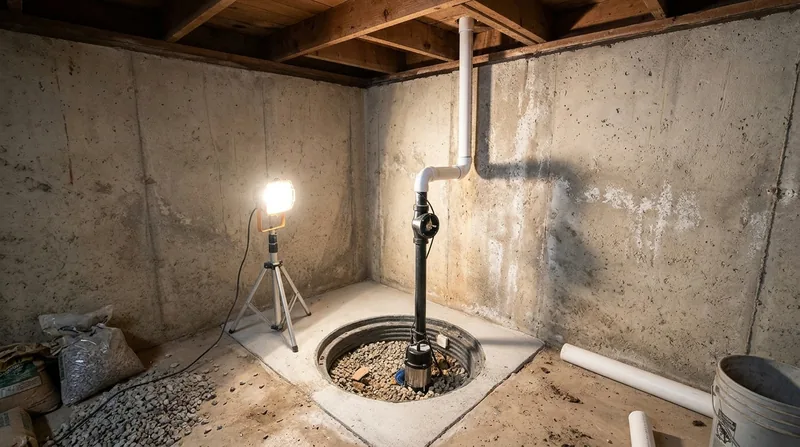




Lincoln sits in the Salt Valley on silty loess and heavy glacial clay, and that clay swells and shrinks with every freeze-thaw cycle. Homes from the Near South and Havelock foursquares to the newer Colonials out in Fallbrook and Waverly all share the same weak point: water stacking up against the footing faster than it can drain away. When a sump pump quits during a prairie thunderstorm, or a builder-grade unit was never sized for the volume, the basement floor tells you within the hour. We handle Sump Pump Installation & Replacement in Lincoln as a dedicated below-grade trade, not a side job for a plumber or a general foundation firm. A properly sized pump, a sealed basin, a working check valve, and a discharge line that actually carries water away from the house are what keep a finished basement dry. If you are still mapping the problem, start with a free basement inspection and we will tell you plainly whether you need a new pump or a full drainage correction.
Why Sump Pump Failure Is the Number One Wet Basement Call in Lincoln
Lincoln gets fast prairie thunderstorms that dump an inch or more in under an hour, and the high water table along Salt Creek, Antelope Creek, and Haines Branch has nowhere to go when the ground is already saturated from spring snowmelt. In the older brick and stone basements of University Place and Clinton, the footing drain is often clay tile that has shifted or silted shut, so the sump basin becomes the only outlet. In the 1990s and newer poured-wall homes out toward Hickman and Bennet, the pump is usually the sole line of defense and builders frequently installed a unit at the low end of the needed capacity.
- The pump runs constantly during a storm and burns out the motor or trips the thermal overload.
- The check valve fails and water drains back into the basin after every cycle, so the pump short-cycles.
- The discharge line is routed into the sanitary sewer or ends two feet from the foundation, sending water right back to the footing.
- The basin is unsealed and soil, gravel, and debris clog the intake, cutting flow when you need it most.
- The float switch sticks in the off position after a dry winter, and the first big rain floods the floor.
Any one of these turns a minor seep into a wet basement within a single storm, and the fix is usually a correctly sized pump and discharge correction rather than a full excavation.
Key info: A 1950s ranch off Woods Park with a partly finished basement called us after a July downpour. The original 1/3 HP pump had been running nonstop for two hours and finally quit. We replaced it with a 1/2 HP cast-iron unit, sealed the basin lid, and extended the discharge 12 feet downslope. No drain tile work was needed, and the floor stayed dry through the next storm.
For the city's own guidance on grading and stormwater discharge, the City of Lincoln website is the reference point, and local rules on where a sump discharge can legally terminate are worth checking before any replacement.
How We Install or Replace a Sump Pump in a Lincoln Basement
Every job starts with the water, not the pump. We look at where the water is entering, how fast the basin fills during a simulated high-flow test, and where the discharge can legally and practically go. On a 1920s foursquare in Near South, that often means working around a shallow stone footing and a basin tucked into a corner. On a 2010s walkout in Fallbrook, it means checking that the builder's discharge line is not buried under the patio and frozen shut in January. The process is the same either way.
- We inspect the existing basin, pump, float, check valve, and discharge line and measure actual inflow rate.
- We size the pump to the measured volume and the static head, typically 1/3 to 3/4 HP for a Lincoln residential basement.
- We set or replace the basin, seal the lid, and install a cast-iron or thermoplastic pump with a reliable vertical float or diaphragm switch.
- We install a brass or PVC check valve and a discharge line pitched to drain fully, with a freeze-resistant termination well away from the foundation.
- We run a full fill-and-pump cycle test and confirm the float trips at the right level before we leave.
If the basin fills faster than any pump can handle, the honest answer is that a pump alone will not solve it, and an interior drain tile system is the better investment than a larger pump.
Key info: A split-level in Eastridge had a pump that cycled every 90 seconds all spring. The check valve was missing and the discharge ran into a floor drain tied to the sanitary line, which is not allowed for storm water. We added a check valve, rerouted the discharge to daylight at the grade break, and the cycling stopped immediately.
Sump Pump Approaches We Use in Lincoln Homes
Not every basement needs the same setup. The right approach depends on the basin condition, the inflow rate, and whether the home already has a working footing drain. Here is how the main options compare for Lincoln housing stock.
| Approach | Description | Best for |
|---|---|---|
| Direct pump replacement | Swap the failed unit for a correctly sized pump, reuse a sound basin and discharge if they pass inspection. | Homes with a working basin and a pump that simply wore out. |
| New basin and pump installation | Cut and set a new sealed basin, install pump, check valve, and a fresh discharge line. | Older homes with a cracked or undersized clay or concrete basin. |
| Discharge line correction | Reroute the discharge to a legal, freeze-resistant termination away from the footing. | Homes where water is being pumped right back against the foundation. |
| Pump plus battery backup | Primary pump with a DC backup that runs on battery during power loss. | Finished basements and homes that lose power in summer storms. |
| Pump with interior drain tile | Perimeter drain feeding the basin when hydrostatic pressure exceeds what a pump alone can handle. | Basements where water enters at the wall-floor joint across the whole perimeter. |
The table is a starting point, and the on-site inspection is what confirms which row actually fits your basement.
Sump Pump Installation & Replacement Cost in Lincoln: What to Expect
Most straightforward pump replacements in Lincoln start around From $1,200, which covers a correctly sized cast-iron pump, a new check valve, and a basic discharge correction. The number moves up from there based on a few concrete factors, and we quote them separately so you can see what you are paying for. A new sealed basin in a 1920s stone-wall basement takes more labor than a drop-in swap in a 2005 poured-wall home, and the discharge routing is often the biggest variable.
- Pump capacity and construction: a 1/2 HP cast-iron unit costs more than a 1/3 HP thermoplastic one, and lasts longer under Lincoln's storm loads.
- Basin condition: cutting out and setting a new sealed basin adds labor compared with reusing a sound one.
- Discharge routing: a short run to daylight is cheap, while a long buried line to a legal termination point costs more.
- Battery backup: adding a DC backup system is a separate line item and worth pricing at the same time.
- Access: a tight mechanical closet or a finished ceiling in the basement slows the work and adds time.
Getting two or three written estimates is the smart move, and it also tells you whether a contractor is quoting the pump you actually need or just the one on the truck. Our full pricing overview lays out the line items in more detail.
Hiring a Sump Pump Contractor Near Lincoln: What to Check
Anybody with a truck can sell you a pump, and the difference shows up two summers later when the float sticks or the discharge freezes. When you search for a sump pump contractor near me in Lincoln, these are the things worth confirming before you sign anything. A few minutes of checking saves a flooded basement.
- Confirm the company is licensed and insured, and ask for a certificate of insurance before work starts.
- Get two or three written estimates that itemize pump model, basin work, and discharge routing separately.
- Ask for references from Lincoln-area homeowners with basements similar to yours, and call them.
- Ask who pulls any required permit, because work that alters the drainage or the sanitary connection of a sump discharge may need one, and the local building department sets the rules.
- Check for HOA requirements if you live in a newer Fallbrook or Waverly subdivision, since discharge termination points are sometimes restricted.
If a contractor cannot answer these questions plainly, keep looking. You can reach us directly through the contact page to schedule an inspection and get a written estimate.
Sump Pump Installation & Replacement in Lincoln: Pricing Guide
| Service | Price | Details |
|---|---|---|
| Direct pump replacement | Starting at $1,200 | Includes a correctly sized cast-iron pump, new check valve, and basic discharge correction using the existing sound basin. |
| New basin and pump installation | Starting at $1,850 | Covers cutting and setting a new sealed basin plus pump, check valve, and fresh discharge line in an older basement. |
| Pump with battery backup system | Starting at $2,400 | Primary pump plus a DC backup that runs on battery during power loss, priced as a combined installation. |
| Pump with interior drain tile | On estimate | Perimeter drain feeding the basin, priced after an on-site look because footage and wall condition vary widely. |
| Discharge line correction only | Starting at $650 | Reroutes an existing discharge to a legal, freeze-resistant termination away from the foundation. |
| Estimate | Free | Response within 24 hours at (531) 229-0952, no obligation to book the work. |
Indicative pricing, the exact cost depends on square footage, finish, and site access. Free personalized estimate within 24h at (531) 229-0952.


