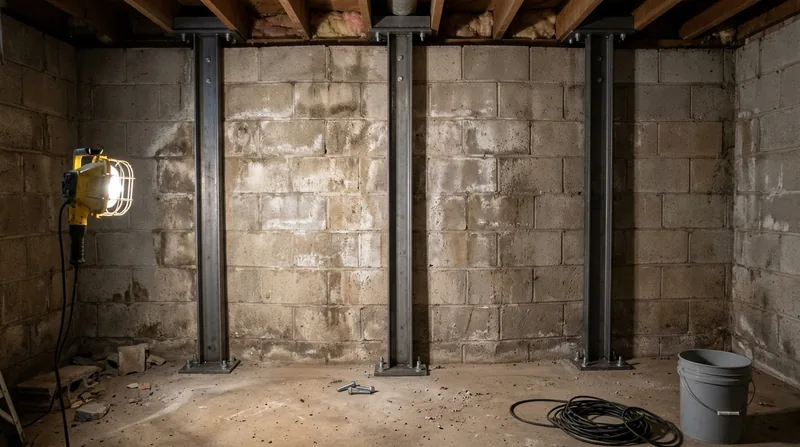




A Bowing Wall Repair in Lincoln is rarely cosmetic. When a basement wall starts to lean inward, the cause is almost always lateral soil pressure acting on a wall that was never built to resist it. Lincoln sits in the Salt Valley on silty loess and heavy glacial clay, and that clay swells hard with every wet spring and shrinks back in a dry August. In the Near South and Havelock, the brick and stone basement walls under 1900s foursquares and Craftsman bungalows have taken a century of that cycle. In Fallbrook, Waverly and Hickman, poured walls from the 1990s and 2000s are now showing the first signs of movement where backfill and clay settle against them. We read the crack pattern, check the wall for plumb, and match the repair to the actual load. Start with a free basement inspection so we can measure the movement before anyone quotes a fix.
Why Bowing Walls Show Up So Often in Lincoln's Clay and Old Brick Stock
Lincoln's problem is not rainfall volume, it is water behavior in the soil. Glacial clay holds water against the foundation instead of draining it away, and the high water table along Salt Creek, Antelope Creek and Haines Branch keeps that clay saturated longer than most homeowners expect. Add a hard freeze-thaw winter and spring snowmelt, and the wall gets pushed inward season after season. The failure mode that dominates here is hydrostatic pressure from saturated clay, not a single event.
- Brick and stone basement walls in Near South, University Place and Hartley bow because lime mortar loses strength over a century of wet and dry cycling.
- 1950s to 1970s brick ranches in Belmont, Irvingdale and Eastridge often have a horizontal crack at mid-wall where the wall is weakest against soil load.
- Poured walls in Fallbrook, Bennet and Eagle show vertical cracks and inward lean where backfill was never compacted properly.
- Older homes with failing footing drains and weeping tile let water pool at the base, which accelerates the lean.
Every one of those patterns points to the same conclusion: the wall is a symptom, and the soil and drainage are the cause.
Key info: A 1920s brick foursquare in Havelock with a two-inch lean at mid-wall is a carbon fiber strap case. A 1960s ranch in Belmont with a wall pushed in four inches and a cracked footing is a steel I-beam and anchor case. The number that matters is not the crack width, it is the amount of movement and whether the wall is still rotating.
Nebraska does not license general contractors at the state level, so local permitting and inspection carry the weight. The City of Lincoln Building and Safety Department handles structural foundation repair permits, and rules on scope and inspection vary by jurisdiction. Verify the current requirements with them before work starts: City of Lincoln Building and Safety.
How We Diagnose and Repair a Bowing Wall in Lincoln
We do not quote a bowing wall from a photo. The first step is a walkthrough of the basement and the exterior grade, because the fix depends on whether the wall is still moving and what is pushing it. We check the wall for plumb with a level, map the crack pattern, look for efflorescence and evidence of past water, and inspect the footing drain and downspout discharge. If the wall is stable and the crack is tight, simple crack sealing may be all you need, and we say so.
- We measure the lean and document it with photos so we have a baseline to compare against later.
- We inspect the exterior grade and downspout extensions to see where water is being dumped against the foundation.
- We check the footing drain and sump basin to confirm whether water is being managed at the base of the wall.
- We recommend the lightest repair that actually addresses the load: carbon fiber straps, wall anchors, or steel I-beams.
- We correct the water source with grading, downspout extension, and drainage work so the repair is not fighting the same pressure next spring.
- We pull the required permit and schedule the inspection before we close up the wall.
The repair stabilizes the wall, but the drainage work is what keeps it from happening again. If the footing drain is failed or missing, that is a separate conversation, and we will point you to drain tile repair and replacement rather than sell you a strap you do not need.
Key info: A split-level in Irvingdale had a wall leaning two inches with a horizontal crack at mid-wall. We installed carbon fiber straps on the interior and extended the downspouts six feet out. Two years later the wall had not moved. A ranch in Hickman with four inches of lean and a cracked footing needed steel I-beams and exterior anchors, because the wall was still rotating at the base.
Repair Methods We Use and What Each One Is For
There is no single right answer for a bowing wall. The method follows the severity of the movement, the wall material, and the soil load. Here is how the options compare in Lincoln's clay.
| Approach | Description | Best for |
|---|---|---|
| Carbon fiber straps | Straps bonded to the interior wall from floor to joist, resisting further inward movement. | Brick or block walls with up to about two inches of lean and no footing crack. |
| Steel I-beams | Vertical steel beams set against the wall and tied into the floor and joists. | Poured walls with deeper lean or where the wall is still actively moving. |
| Wall anchors | Exterior anchor plates tied through the wall to interior plates, pulling the wall back. | Walls with room to excavate outside and movement that can be corrected over time. |
| Crack injection and sealing | Epoxy or polyurethane injection into cracks that are not structural. | Tight, stable cracks with seepage but no measurable lean. |
| Drainage correction | Grading, downspout extension, and footing drain or interior drain work to relieve pressure. | Every bowing wall, because the soil load has to be reduced for the repair to hold. |
The right combination is decided on site, and we will tell you plainly when a strap is enough and when the wall needs more.
Bowing Wall Repair Cost in Lincoln: What to Expect
Most homeowners want a number before they want a diagnosis, so here is the honest version. Carbon fiber strap work starts around $600 for a single strap and scales with the number of straps and the wall length. Steel I-beams, wall anchors, and exterior excavation run higher because of material, labor, and the drainage work that has to go with them. The factors that move the price are the amount of movement, the wall material, access to the wall, and whether the footing drain needs work at the same time.
- Wall material matters: brick and stone take more prep than poured concrete.
- Number of straps or beams is the biggest single driver on a long wall.
- Exterior excavation adds cost, but it is sometimes the only way to correct the lean.
- Drainage correction is often bundled in, and skipping it usually means paying twice.
Get two or three estimates and ask each contractor what they measured and why they chose their method. A quote without a plumb measurement is a guess. Our full pricing overview lays out the ranges, and the on-site visit is what turns a range into a real number.
How to Choose a Bowing Wall Repair Contractor Near Lincoln
Bowing wall work is structural, and the contractor you pick matters more than the method. Ask for proof of license and insurance, and ask for references from jobs in Lincoln, not from out of state. A contractor who has not worked in this clay may underestimate the load. Get multiple estimates, compare what is actually being installed, and confirm who is pulling the permit.
- Confirm the company is licensed and insured, and ask for a certificate of insurance before work begins.
- Ask for local references on bowing wall jobs, not just crack sealing.
- Verify who pulls the structural permit with the City of Lincoln Building and Safety Department.
- Get the scope in writing, including drainage correction and warranty terms.
If a contractor will not put the method and the warranty in writing, keep looking. You can reach us through the contact page to schedule an inspection.
Bowing Wall Repair in Lincoln: Pricing Guide
| Service | Price | Details |
|---|---|---|
| Carbon fiber strap repair (single wall) | Starting at $600 | Includes site measurement, strap layout, and installation; price rises with wall length and strap count. |
| Steel I-beam stabilization | Starting at $1,800 | Includes beams tied into floor and joists; price moves with wall height and access to the basement. |
| Wall anchor system | Starting at $2,500 | Includes exterior excavation and anchor plates; price depends on soil conditions and depth of the lean. |
| Crack injection and sealing | Starting at $450 | Includes epoxy or polyurethane injection for stable cracks; price varies with crack length and number of ports. |
| Complex or large-scale job | On estimate | Multi-wall movement or footing damage needs an on-site structural look before any number is given. |
| Estimate | Free | On-site measurement and written scope within 24 hours at (531) 229-0952, no obligation to book. |
Indicative pricing, the exact cost depends on square footage, finish, and site access. Free personalized estimate within 24h at (531) 229-0952.


