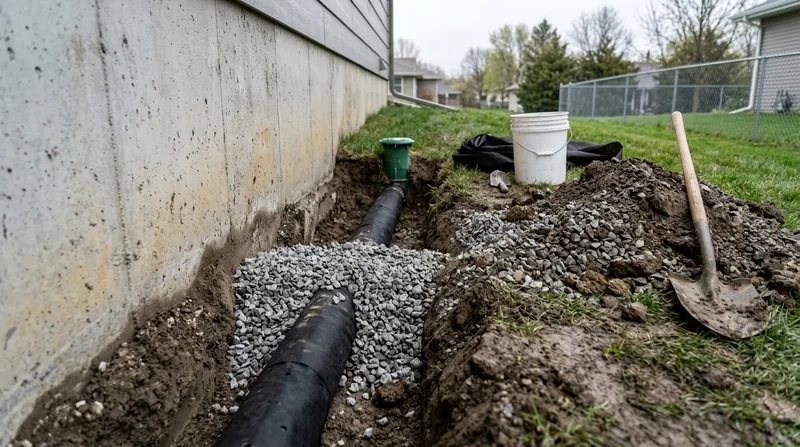




Lincoln sits in the Salt Valley on silty loess and heavy glacial clay, and that clay swells and shrinks with every freeze-thaw cycle. Homes from the Near South foursquares to the 1990s Colonials in Fallbrook all fight the same problem: storm runoff that pools against the foundation because the ground has nowhere to send it. French Drain Installation in Lincoln solves that by intercepting groundwater before it reaches your basement wall, not after it's already soaking the block. We install exterior drains along the footing, properly graded gravel and perforated pipe wrapped in fabric, tied to daylight or a sump basin. If you're seeing efflorescence, wall seepage, or a wet basement after spring storms, this is often the fix that stops the cycle at the source. Start with a free basement inspection so we can tell you whether a drain is the right answer or whether crack sealing is enough.
Why French Drains Matter on Lincoln's Clay and Flat Lots
Most Lincoln neighborhoods were graded for a different era of rainfall. The brick foursquares in Havelock and University Place have downspouts that dump within two feet of the wall, and the lots are flat enough that water sits instead of running off. Add a high water table along Salt Creek, Antelope Creek, and Haines Branch, and you get hydrostatic pressure pushing against basement walls every time the prairie thunderstorms roll through. A French drain gives that water a path away from the footing before it builds up.
- It intercepts groundwater at the footing line, which relieves hydrostatic pressure instead of just patching the symptom.
- It handles flash runoff from fast summer storms that overwhelm gutters and grading in older Lincoln neighborhoods.
- It protects the drain tile and sump basin from silty loess washing in and clogging the system.
- It reduces the standing water that causes wall seepage and efflorescence on brick and stone foundations.
On flat lots in Belmont and Irvingdale, the drain often ties to a sump basin because there is no downhill daylight to discharge to, and that is normal here.
Key info: A 1920s foursquare in Near South with a brick foundation and a downspout dumping at the corner will often show seepage within hours of a storm. That pattern points to surface water and footing drainage, not a failed wall, and a French drain is usually the right first move.
For the official word on grading and drainage requirements, check the City of Lincoln building and development resources at lincoln.ne.gov Building and Safety before you dig.
How We Install a French Drain on a Lincoln Foundation
We start by walking the foundation and reading the water, not by quoting a trench. We look at where the grade falls, where the downspouts land, and whether the wall shows efflorescence or horizontal seepage lines. On poured-wall Colonials in Hickman and Waverly, that walk tells us whether the drain should run the full perimeter or just the wet side. On older stone and brick foundations, we check the mortar joints before we excavate so we know what we're working against.
- We mark the trench line and call for utility locates before any digging starts.
- We excavate to the footing, keeping the trench sloped so water moves toward the discharge point.
- We lay washed gravel, set the perforated pipe with the holes down, and wrap the whole run in filter fabric to keep silt out.
- We tie the drain to daylight on a sloped lot or into a sump basin with a check valve on flat ground.
- We backfill with gravel, restore the grade so it slopes away from the wall, and test the flow before we leave.
Every run gets tested with a hose before we backfill, because a drain that doesn't move water is just a trench.
Key info: A ranch in Eastridge with a partly finished basement had water pooling at the rear wall after every storm. The lot was too flat for daylight discharge, so we ran the drain to a new sump basin and added a battery backup so the pump kept working through the storm. Details on that setup are on our sump pump installation page.
French Drain Approaches We Use in Lincoln
Not every lot takes the same drain. The choice comes down to slope, soil, and whether the water has somewhere to go. Here is how we match the approach to the property.
| Approach | Description | Best for |
|---|---|---|
| Gravity drain to daylight | Gravel and perforated pipe run to a downhill discharge point. | Sloped lots in Roca, Bennet, and Eagle with a safe outlet. |
| Drain to sump basin | Drain feeds a basin and pump that discharges above grade. | Flat lots in Belmont, Irvingdale, and near the Salt Creek floodplain. |
| Perimeter footing drain | Full loop around the foundation at the footing line. | Homes with seepage on more than one wall, common in older foursquares. |
| Partial wall drain | Targeted run on the wet side only, tied to the existing system. | One-wall seepage on 1950s ranches in Woods Park and Eastridge. |
| Drain with fabric wrap | Filter fabric around the gravel and pipe to block silt. | Silty loess and clay soils across the Lincoln metro. |
The right approach is the one that matches your grade and soil, and that is what the site visit is for.
French Drain Installation Cost in Lincoln: What to Expect
Most French drain work in Lincoln starts around $25 per linear foot, and that figure covers excavation, gravel, perforated pipe, filter fabric, and backfill on a straightforward run. The number moves up when the trench has to go deeper, when the lot is too flat for daylight and needs a sump basin, or when access is tight between a house and a fence line. A full perimeter on a large Fallbrook Colonial is a different job than a single-wall drain on a bungalow in Clinton.
Two or three estimates is the smart move, and not just for the price. Ask each contractor how they handle the discharge, whether they wrap the pipe in fabric, and what they do if they hit a utility line. A low bid that skips the fabric or the testing is not a bargain on clay soil. You can see how we break down line items on our pricing page before you call.
Choosing a Waterproofing Contractor Near Me in Lincoln
Hiring for a French drain is not the same as hiring for a roof or a deck. You want a contractor who works below grade every week and can explain why they are recommending a drain instead of excavation or crack injection. Ask for the license and insurance certificate, and confirm the coverage is current before work starts. Get at least two or three written estimates that spell out the pipe, the gravel, the fabric, and the discharge plan.
Call references from jobs done at least a year ago, and ask whether the basement stayed dry through a spring snowmelt. If the property is in a neighborhood with an HOA, check the rules on discharge location and grading changes before the trench goes in. Permits for work that alters drainage or the sump discharge connection vary by jurisdiction, so confirm with the local building department. When you're ready, reach us through the contact page and we'll set up the walkthrough.
French Drain Installation in Lincoln: Pricing Guide
| Service | Price | Details |
|---|---|---|
| Partial wall French drain | Starting at $25/linear ft | Covers excavation, gravel, perforated pipe, filter fabric, and backfill on a single wet wall. |
| Full perimeter footing drain | Starting at $32/linear ft | Full loop at the footing line, priced higher for depth, length, and tight access between structures. |
| Drain tied to sump basin | Starting at $1,800 | Includes basin, pump, check valve, and discharge line for flat lots with no daylight outlet. |
| Complex or large-scale job | On estimate | Multi-wall runs, utility conflicts, or stone foundations need an on-site look before a number is given. |
| Travel | Included | In Lincoln and surrounding areas, no separate call-out or mileage fee. |
| Estimate | Free | Response within 24h at (531) 229-0952, no obligation to book. |
Indicative pricing, the exact cost depends on square footage, finish, and site access. Free personalized estimate within 24h at (531) 229-0952.


