



Foundation Crack Repair in Lincoln: Stop Water Before It Finds Your Basement
Lincoln sits in the Salt Valley on silty loess and heavy glacial clay, and that clay swells with every wet spring and shrinks through hard freeze-thaw winters. In the brick foursquares of Near South and Havelock, the poured-wall ranches of Irvingdale and Belmont, and the newer Colonials out in Fallbrook and Hickman, that seasonal movement shows up as foundation cracks and wall seepage. Foundation Crack Repair in Lincoln means matching each crack to the right method: epoxy or polyurethane injection for tight, non-structural cracks, and structural options when the clay has actually moved the wall. We inspect the crack, read the wall, and tell you plainly whether simple sealing is enough or whether hydrostatic pressure is the real problem. If you also see water at the cove joint, start with our basement waterproofing service page before you spend money on a patch.
Why Foundation Cracks Show Up in Lincoln's Clay and Loess Soil
The dominant failure mode here is not a single event. It is the seasonal swell-shrink cycle of glacial clay, loaded on top of a high water table along Salt Creek, Antelope Creek, and Haines Branch. Fast prairie thunderstorms push hydrostatic pressure against the wall, and spring snowmelt does the same at a slower pace. Cracks that look cosmetic in August often weep brown water by April.
- Vertical cracks in poured walls usually come from shrinkage and settlement, and they are the best candidates for injection.
- Stair-step cracks in brick or block walls often follow mortar joints and point to movement, not just shrinkage.
- Horizontal cracks and inward bowing mean the clay is pushing the wall, and injection alone will not fix that.
- White efflorescence on the wall face is the mineral signature of water moving through concrete, even when the crack looks dry today.
- Wet spots at the cove joint or floor crack usually mean water is coming up, not through, and the answer is drainage.
Read those signs correctly and you avoid paying twice for the same problem.
Key info: In the 1900s brick foursquares of University Place and Hartley, we routinely find vertical cracks that have been parged over three or four times. The parging hides the crack but does nothing about the water behind it. Injection ports drilled through the patch and into the crack itself are what actually stop the seepage.
For the official word on what work needs a permit, check the City of Lincoln building and safety department before structural repair begins; thresholds vary and must be verified for your address.
How We Diagnose and Repair Foundation Cracks in Lincoln
Every crack gets inspected before it gets a price. We look at width, direction, and depth, then check for efflorescence, rust staining, and any sign the wall has moved out of plumb. We also look at grading and downspout extension, because a crack that keeps getting fed will keep opening. Only then do we choose the method.
- We walk the basement and mark every crack, noting which ones are active and which are dormant.
- We check the wall for bowing with a straightedge and plumb line, and photograph anything that suggests structural movement.
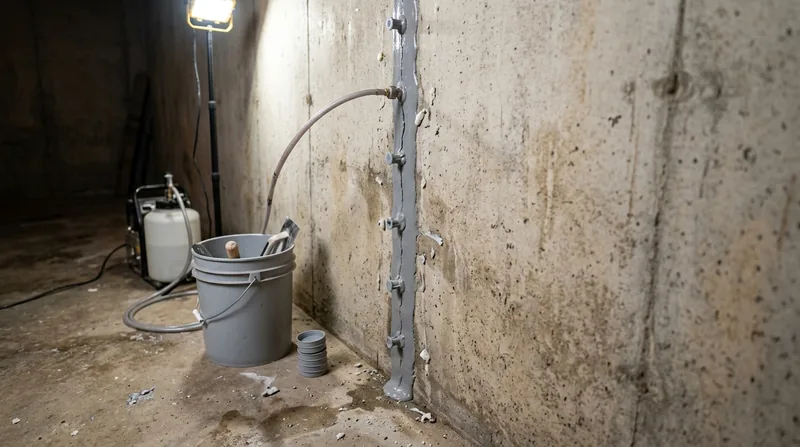
- We drill injection ports at an angle across the crack so the resin reaches the full depth of the wall.
- We flush the crack with water or compressed air, then inject epoxy or polyurethane from the bottom port up until material pushes out at the next one.
- We seal the surface, trim the ports flush, and leave the wall ready for paint or parging.
- We hand you a written summary of what we found, what we injected, and what to watch for next spring.
If the inspection shows the wall is bowing rather than just cracked, we say so and point you to bowing wall repair instead of selling you an injection that will not hold.
Key info: A 1960s split-level in Eastridge had a hairline vertical crack that had been caulked twice. Our inspection found the crack was wet only after rain, and the downspout dumped within two feet of the corner. We injected the crack with polyurethane and extended the downspout, and the wall has stayed dry through two spring melt cycles.
Injection Methods and Repair Options Compared
The table below is the short version of how we match a crack to a method. Width, movement, and water activity drive the decision more than any single rule of thumb.
| Approach | Description | Best for |
|---|---|---|
| Epoxy injection | Structural resin injected under pressure that bonds the crack faces back together. | Dry, tight vertical cracks in poured walls where structural bonding matters. |
| Polyurethane injection | Flexible foam resin that expands and stays elastic in the crack. | Active leaks and cracks that move slightly with the seasons. |
| Surface sealing and parging | Hydraulic cement or masonry patch on the wall face. | Cosmetic dressing only, never a stand-alone fix for an active leak. |
| Carbon fiber straps | Straps anchored to the floor and sill to resist inward wall movement. | Horizontal cracks and early bowing from clay pressure. |
| Wall anchors | Exterior anchors that pull a bowed wall back toward plumb. | Walls that have moved measurably out of line. |
If the crack is dry and tight, injection is usually the whole job. If water is coming through the floor or cove joint, the crack is a symptom and an interior drain tile system is often the better answer than exterior excavation.
Foundation Crack Repair Cost in Lincoln: What to Expect
Most single-crack injections in Lincoln start at $450, and that figure covers the inspection, port drilling, resin, and cleanup. From there, price moves with crack length, wall thickness, access, and whether the crack is active or dormant. A short vertical crack in a poured wall is a very different job from a stair-step crack in a 1920s brick foundation that needs repointing before injection.
Getting two or three estimates is smart, not suspicious. Ask each contractor what method they plan to use and why, and whether the price includes the inspection and any surface repair. A quote that does not name the method is a quote you cannot compare. Our full pricing overview lays out the ranges so you can sanity-check what you are hearing.
Be wary of any bid that jumps straight to exterior excavation for a single vertical crack. In most Lincoln homes, that is a drainage solution being sold for a crack problem.
Foundation Crack Repair Near Me: How to Vet a Lincoln Contractor
Searching for foundation crack repair near me in Lincoln returns a long list, and the differences between those companies matter. You want a contractor who inspects before pricing, names the method in writing, and tells you when a cheaper fix is the honest one. Here is what to check before you sign.
- Confirm the company is licensed and insured, and ask for a certificate of insurance before work starts.
- Get at least two written estimates that specify epoxy versus polyurethane and include the inspection.
- Ask for references from Lincoln addresses with similar wall types, not just newer suburban builds.
- Ask whether structural repair or drainage changes need a permit from the local building department, and who pulls it.
- Check HOA rules in subdivisions like Fallbrook or Hickman before any exterior work touches shared grading or easements.
If a contractor cannot answer those questions on the phone, they are not the one to trust with your foundation. You can reach us directly through the contact page to schedule an inspection.
Key info: We serve Lincoln and the surrounding towns, including Waverly and Hickman, where newer poured walls still crack from settlement and clay movement. The method is the same; the wall age changes what we find behind it.
Foundation Crack Repair in Lincoln: Pricing Guide
| Service | Price | Details |
|---|---|---|
| Single vertical crack injection | Starting at $450 | Includes inspection, port drilling, epoxy or polyurethane resin, and cleanup for one typical crack. |
| Multiple crack injection | Starting at $750 | Priced per crack after inspection; longer or active cracks and limited access move the number up. |
| Structural repair (carbon fiber or anchors) | On estimate | Needs an on-site look at wall movement, crack width, and access before any number is given. |
| Travel | Included | In Lincoln and surrounding areas, with no separate call-out or mileage fee added. |
| Estimate | Free | Response within 24 hours at (531) 229-0952, with no obligation to book. |
Indicative pricing, the exact cost depends on square footage, finish, and site access. Free personalized estimate within 24h at (531) 229-0952.


